
A story of second chances, books in a crowded cell, and a fight to learn.
Mwendwa Kilatya, 34, never imagined that a KES 1,000 errand would cost him four years of his life.
In 2021, a man asked him to deliver a cow to a butchery in Mpeketoni. He was told exactly where the animal was tethered. He did the job and collected his pay.
But when a vet examined the cow, he found it was pregnant.
“No cow owner would sell a pregnant animal,” the vet said. That one detail raised suspicion.
Kilatya was arrested at Mpeketoni. In court he pleaded guilty, telling the magistrate he was only the messenger. The man who had sent him was also arrested.
The judge was lenient: four years in jail or a fine of Sh100,000.
Kilatya could not raise the money. He went to prison.
His co-accused paid the fine and walked out the same day.
He also left behind a family. He had a wife and one child. His wife came to see him once while he was in remand. She never returned.
“My wife came to see me in remand. I explained to her my situation and she went back home promising to organize for payment of the fine so that I could be released.She never came back,” he says.
Kilatya says she had been operating a tailoring business near their home in Kitui. Communication through phone was not easy as it is prohibited to have phones inside the cells. When Kilatya managed to call her phone again it was ‘mteja’ translated loosely to mean switched off.
When he later called a neighbor,the neighbour told him she had left together with their son and had carried away all the household items. The neighbour told him she had been remarried.
"I agonized over the matter but what else could I do? I never looked for her again," he said.
“My father Kilatya Nthenge died when I was young. My mum Rose Mutheu also died about 20 years ago.”
Born in a family of nine (9) siblings, five boys and four girls, Kilatya was the seventh born in the family.
His mother used to operate an hotel in Mutomo, Kitui.
His father Kilatya Nthenge died when he was young and his mum Rose Mutheu also died about 20 years ago.
Back to Prison. Prison life was harsh.
“One small room can hold up to ten inmates,” Kilatya says. “Even sleeping is a problem.”
At the Coast the situation was worse. The heat is relentless. The air in the cells feels heavy. Tempers are short.
And then there was school — or the lack of it.
“When I joined, there was no school section in the prison,” he recalls.
“There were no adequate books or teachers. Sometimes the wardens were rough and uncaring. They beat you up if you try to bother them and remind you that you did not come to prison to study.”
For many, that would be the end of the story. For Kilatya, it was the beginning.
Kilatya approached one of the prison teachers, Mr Frank Maduga, with a request that sounded impossible: start a school inside.
At first there was nothing. No classroom, no desks, no syllabus. But Kilatya kept pushing. He asked to be transferred to a prison with a school, or to have one started where he was.
Mr Maduga took the matter up with his superiors. Letters were written. The Ministry of Education came to inspect.
Eventually, the centre was registered.
Kilatya joined the pioneer class.
“He was hardworking and gave us the morale to continue teaching,” Mr Maduga says.
“Even with the congestion, even with the heat, he would sit and read.”
Slowly, things changed. Donations and government support brought in books, pens, and geometrical sets. By 2025, five inmates had registered and sat for KCSE. Kilatya was among them.
“We used to be three teachers but sometimes, personally, when I felt like giving up he was the only reason that kept me going. He used to say ‘anatamani kuwa na kazi nzuri ya kuvaa smart.’ When I missed a lesson he could ask me ‘Mr where were you? We were so bored when you were not around to teach us’.” recalls Mr Maduga.
After serving his sentence, Kilatya walked out of prison. But freedom came with new questions: What next? How does a former inmate continue with education when fees, stigma, and lack of support stand in the way?
He decided not to stop.
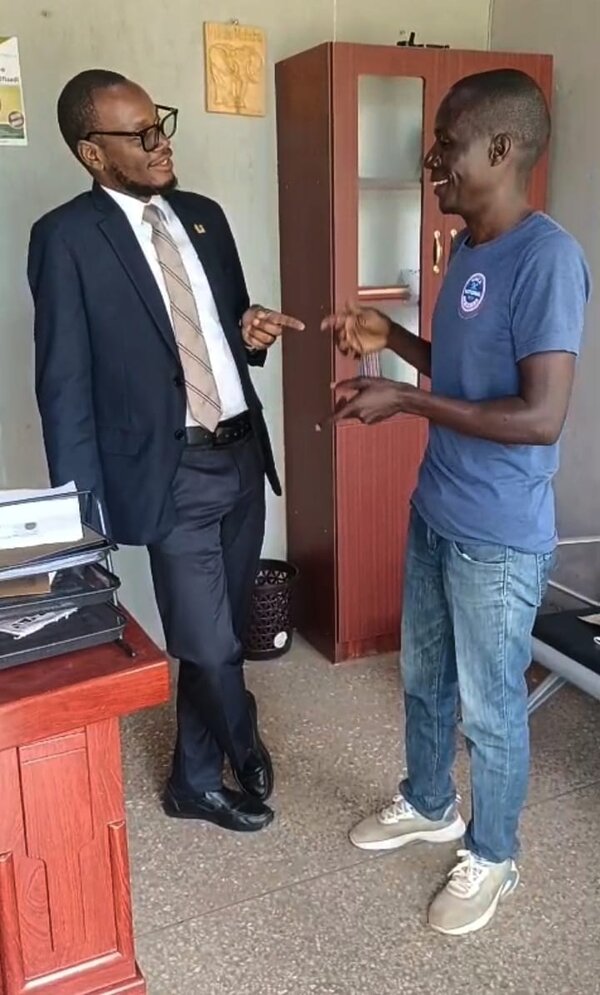
In a bold move, Kilatya sought out Wamunyu law Court in Mwala Sub -County,Senior Resident Magistrate Eugene Pascal, the same judicial officer who had handled his case and matters related to rehabilitation and access to justice in the area. He went to ask for assistance to continue with his studies.
“I looked for you because it is difficult to get a job without certificates. I wanted to do Business Management,” Kilatya told the same magistrate who had jailed him.
Magistrate Pascal stared at him, then smiled.
“You say I jailed you in Lamu and now you've sought me here in Machakos, why?” he asked
He explained his story: how he learned in prison, how he sat KCSE, and how he now wanted to join college or tertiary training. He asked Hon. Pascal and well-wishers to help him get fees, learning materials, and a chance to enroll for a certificate course in Business Management.
Magistrate Pascal listened. For the judiciary, Kilatya’s case represented exactly what the law hopes for — rehabilitation, not just punishment.
Magistrate Pascal says he doesn’t have the funds personally, but he will not let the story end here.
“I’m happy that Mwendwa has reformed and is ready to pursue education,” Pascal said.
“I don’t have the money myself, but I will look for friends who can sponsor him to pursue the course of his dreams.”
For Kilatya, that D Plain is more than a grade. It’s proof that the words of encouragement spoken by Magistrate Pascal during a visit to Hindu Prison did not fall on deaf ears.
The Judge encouraged them to study as education could unlock doors.
"Witnessing Kilatya’s profound focus and map for the future was a true masterclass in resilience. He didn't just reform; he rose, challenging me to look at my own journey. By grace, my story found a voice, but countless judicial officers continue to quietly reshape society without recognition. I encourage our media to seek out and amplify these vital stories of hope nationwide," the Wamunyu law Court Senior Resident Magistrate said.
He says if he gets support, he won’t stop at a certificate.
“I will consider studying further as opportunities arise.”
Mr Maduga, who taught Kilatya behind bars, is fond of Kilatya. He urges other young people not to despair whenever they find themselves in similar situations.
“I urge young people who have found themselves in conflict with the law to pursue education while in prison,” he says.
“Let them not give up because as long as you are alive you can become anything.”
He notes that the prison school is now better equipped and continues to admit new learners.
“We started with nothing. Today we have books. We have students passing. That started because one inmate refused to accept that prison was the end.”
For Kilatya, the cow that led him to jail also led him to a classroom. And the classroom may now lead him to college.
As he waits for a response from Magistrate Pascal and other education stakeholders, Kilatya ekes out a living doing casual labour at construction sites in Machakos whenever the opportunity arises.
It is a back-breaking job but he has to endure in the hope that his Form Four certificate and perhaps an additional certificate which he hopes to acquire will one day open doors to a decent job where he can earn better pay,and dress smartly like Wamunyu resident magistrate Eugene Pascal.
Be the First to Comment