
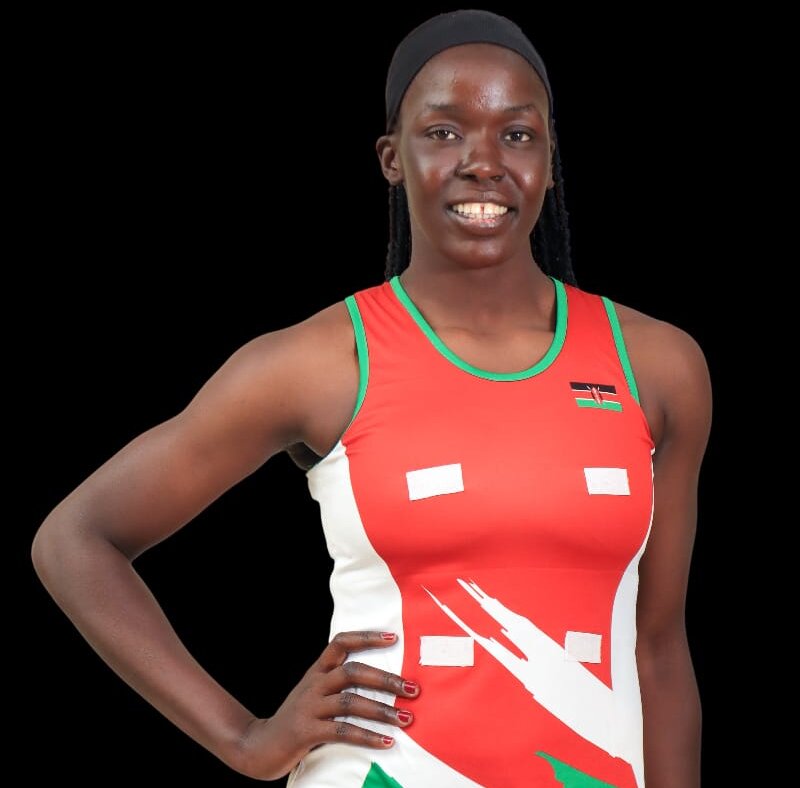
When Lydia Atieno Nyapere first encountered netball at Lala Secondary School in Homa Bay County, she wanted nothing to do with it.
In fact, whenever games time arrived, Nyapere would disappear.
She would hide from the teachers and coaches, doing everything possible to avoid stepping onto a netball court.
At the time, she could not imagine that the sport she was running away from would one day become her career, take her across Africa and make her Kenya’s first professional netball player to ply her trade abroad.
Today, Nyapere is playing in Zimbabwe’s Premier League for Makate High Flyers, having secured a release from Kenya Prisons to pursue the historic opportunity.
The journey from an unwilling schoolgirl to an international player, however, has been anything but straightforward.
“I started playing netball when I was in Form Two. I didn't start willingly. It was kind of forced,” recalls Nyapere.
Her reluctance did little to discourage her coaches and games teachers.
Led by her foundation coach, Peter Oloo, who is now coach of the Kenya men’s national netball team, they kept looking for her and encouraging her to play.
It eventually worked.
By Form Three, Nyapere had become an active netball player, discovering a talent she herself had never recognised.
“I didn't realise it, but I guess that was my talent. At the moment, I never thought I had a talent. You could ask me, ‘Lydia, do you have a talent?’ I would say no,” she says.
Her coaches saw something different.
After leaving school, she joined Sophia Queens, a Homa Bay club owned by Oloo. It was while representing the club at county-level competitions that her performances caught the attention of Kenya Prisons scouts.
She joined Kenya Prisons as a civilian and played for the team for almost two years before being employed by the institution. She then underwent nine months of paramilitary training before returning to sporting duties.
With Kenya Prisons, Nyapere established herself as a formidable shooter and helped her team win championships, while individual performances saw her recognised as a best shooter and, on occasions, player of the tournament.
But the national team door proved harder to unlock.
Nyapere received her first call-up in 2021, only to be dropped. It happened repeatedly, she says, over a period stretching several years.
Looking back, she identifies one major reason: discipline.
“I think my discipline contributed on the higher side. That caused me to always be dropped when the final list was being mentioned,” she admits.
The painful experience became a turning point.
She learnt to accept correction, respect coaches and teammates and listen even when advice came from younger players.
“I had to correct my attitude. I had to be disciplined to my coaches and my players, ready to have corrections,” she discloses.
That change eventually earned her a place in the national team’s final 12.
Her breakthrough came on the international stage when she represented Kenya in Singapore, helping the country win gold.
Since then, she has represented Kenya at major assignments in Zimbabwe and Malawi, building herself into an established international player.
It was during one of Kenya’s engagements in Zimbabwe that another door opened.
Zimbabwean officials were looking for an international player, and Nyapere attracted their attention.
The opportunity was significant for both player and league. She became the first foreign player to feature in the Zimbabwean league, according to Nyapere.
For her, the move was the fulfilment of something others had seen long before she did.
“Generally, it's God's favour because it feels really good,” she observes.
Her move was facilitated by her coaches, Kenya Netball Federation president Immaculate Kabutha and Kenya Prisons, which had to navigate the formal process of releasing a serving officer to play abroad.
Eventually, the paperwork was completed and Nyapere left for Zimbabwe.
The transition has demanded more than simply adapting to a new team.
Zimbabwe has a higher-ranked netball programme than Kenya, and Nyapere says the southern African style differs considerably from what she was accustomed to in East Africa.
For the shooter, that has meant learning, unlearning and adapting.
“I have to unlearn my eastern side of netball to learn the southern side of netball because I have to play the way they play now,” she says.
Away from the court, Zimbabwe has also presented its own lessons.
She has had to adjust to different food, weather and language. Among the foods she has tried are caterpillars, something she had never eaten in Kenya.
Winter has been another shock.
Coming from Kenya, she found Zimbabwe’s cold season particularly demanding.
Then there is Shona, the dominant local language.
Although English helps her communicate, Nyapere has found herself in situations where people do not speak it. She has picked up a few Shona words that resemble Swahili and often relies on her coach to translate.
Yet perhaps the biggest challenge has been emotional rather than sporting.
Being away from home has brought homesickness, especially when she misses her family.
For Nyapere, who describes herself as an athlete, mother and wife, balancing professional sport with family responsibilities is another demanding part of her life.
Her typical training day can run from 8.00am to 2.00pm, leaving her to return home and attend to family and other responsibilities.
“It hasn't been easy,” she says.
But her family has remained a source of strength.
Her mother initially did not understand why she was so committed to sport. That changed when she realised that netball could provide a career. Her father has always supported her, while her fiancé, she says, has been her biggest fan.
Nyapere's sporting roots also run through her family.
Her twin sister Beryl was a talented long-distance runner who won several medals in high school, but stopped competing after graduation due to a lack of opportunities. An elder sister is also involved in sport as a school coach.
Nyapere, however, is now the family's leading athlete.
Her rise has also been shaped by role models.
As a shooter, she admired Kenyan international Hellen Sinoya, studying her movement and hoping one day to replicate her skills.
For the men's game, Kenya Prisons player Ochuka John served as both a role model and mentor, particularly in helping her deal with discipline and attitude.
Internationally, New Zealand's Grace Nakeia has been an inspiration.
Nyapere's growing reputation has also earned her colourful nicknames. The most prominent is “Daktari”, given to her by national team captain Parin Simiyu because of her physical style of play.
The nickname later evolved into “Surgeon” after Simiyu joked that the doctor had graduated.
Nyapere laughs off the many names teammates have given her, saying she has learnt to accept them because the explanations behind them are often difficult to dispute.
At 28, Nyapere's journey is a powerful reminder of how talent can emerge from unlikely beginnings.
She never played sport in primary school. She initially resisted netball. She was repeatedly dropped from the national team.
Yet each setback became part of the road to Zimbabwe.
Now, from the courts of Homa Bay to the Zimbabwean Premier League, Nyapere is helping change perceptions about what a netball career can offer Kenyan players.
Her message to young athletes is simple: take talent seriously, but never separate it from discipline.
“Netball is a career. Netball can pay your bills. Netball can change your life,” she advises.
For the girl who once hid whenever she saw a netball pitch, those words carry particular weight.
The sport she once avoided has not only become her profession. It has become her passport to the world.
And Zimbabwe, she says, is increasingly beginning to feel like another home.
Comments :