
In two weeks time, three men convicted of murder, including former Migori County Governor Okoth Obado, will learn their sentences for the brutal killing of Sharon Otieno.
The trio was found guilty 43 days ago by Justice Cecilia Githua of the Milimani High Court.Obado, 64, his former personal assistant Michael Oyamo and county employee Casper Obiero were convicted of murdering Sharon and her unborn baby boy.
A check by Justice Gauge at the high-security Kamiti Maximum Prison established that Obado and his two co-convicts are well.
His lead defence lawyer, Senior Counsel Kioko Kilukumi, who visits him regularly, told Justice Gauge on Friday that the former governor is in good health and awaiting sentence after mitigation.
“When I visited Obado at Kamiti Maximum Prison he was fine and in good health,” SC Kilukumi said.
“The former governor is okay and waiting to receive sentence after mitigation on September 16, 2026,” SC Kilukumi added.
Obado was convicted together with his former personal assistant Michael Oyamo and former county employee Casper Obiero for the cold-blooded murder of Rongo University student Sharon Otieno and her unborn baby boy.
Sharon was abducted, raped and murdered on the night of 3–4 September 2018 in a forest at Owade in Homa Bay County.
A senior prison officer at Kamiti told Justice Gauge on Friday (September 4, 2026) that Obado, like any other convict, is permitted to attend church on Saturday because he is a Seventh-day Adventist.
Other inmates may attend church on Sundays. Prisoners are allowed to read the Bible or the Quran according to their preference.He is also permitted to receive visitors, though for limited periods.
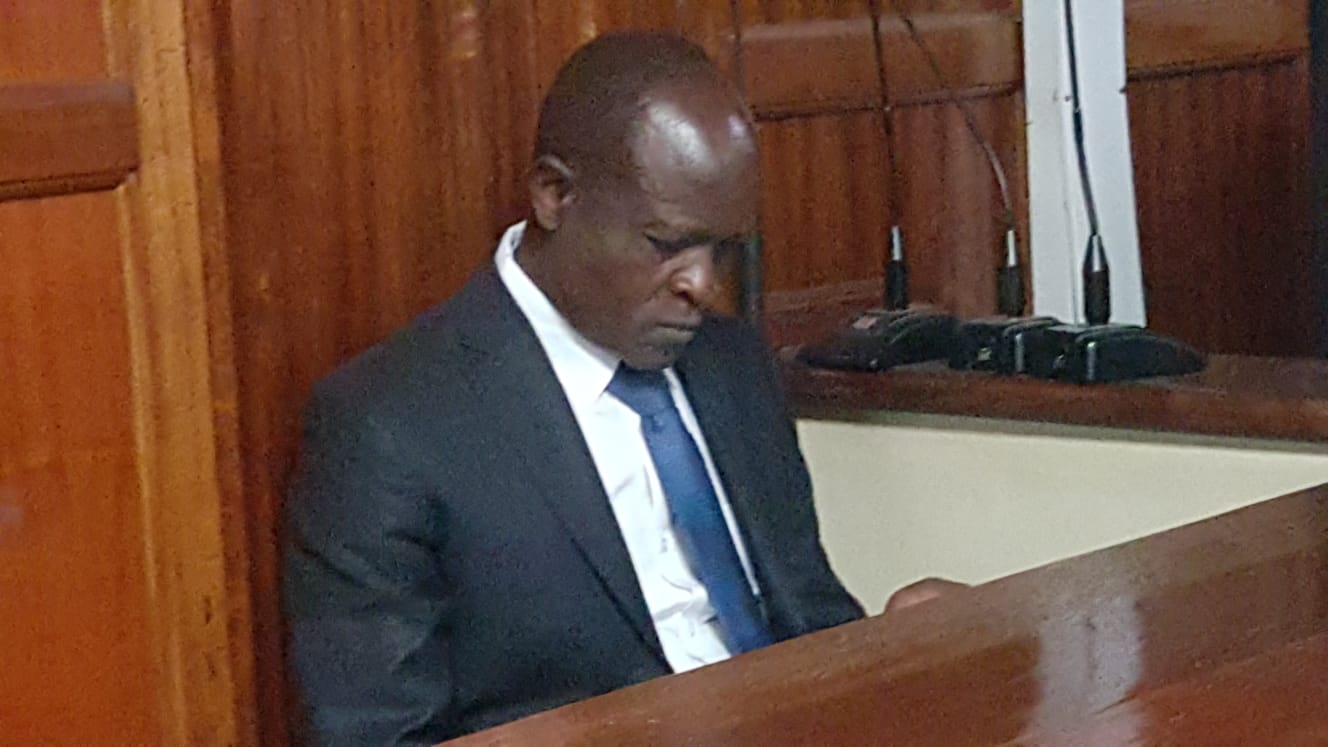
As he has not yet been sentenced, he has not been issued with prison uniform and continues to wear civilian clothes.
“Just like any other convict before sentence, Obado is allowed to put on his own clothes. He will be given prison attire after his sentence,” the prison warder who spoke to Justice Gauge stated.
Immediately after the convictions, trial judge Justice Cecilia Githua ordered a pre-sentencing report for Obado, Oyamo and Obiero.
She also directed that a victims’ impact report be prepared before the convicted men are invited to mitigate prior to sentencing.
The probation office has since interviewed Sharon Otieno’s family and submitted a report.
The family informed the probation officer that it is open to reconciliation with Obado’s family, despite the pain and anguish endured since the university student was abducted, raped and murdered in September 2018.
In the victim impact statement filed in court by the Probation and Aftercare Service, Sharon’s parents said they harbour no hard feelings towards Obado’s family and hope that efforts to reconcile the two families can continue.
They reported that a reconciliation meeting took place in August, led by Obado’s brother Dominic Peter Akugo, Daudi Okoth, and his sister-in-law Lenah Awino.
Sharon’s family was represented by her parents Douglas Zacharia Otieno and Melida Auma, her aunt Benta Rose, uncles and grandmother Rose Ndege.
The family also expressed hope that Obado would honour a promise he made to Sharon before her death to buy her a plot and build her a house.
“The reconciliation meeting struck some ground where representatives of the first accused/offender, which included his two brothers and a sister-in-law, met with the victim’s family and agreed that the first accused had made some promises to the deceased and that they were still committed to fulfilling them,” the report stated.
According to the report, fulfilling the promise would assist Sharon’s three children, who are being raised by her parents.
During the trial it emerged that Sharon had reportedly sought a house valued at KES 25 million, among other requests.
The family said such support would ease the economic burden caused by her death, particularly the cost of raising the orphaned children aged 12, 10 and eight years.
They noted that it had been difficult to explain to the children what had happened to their mother, with the younger ones still seeking answers.
“The death of Sharon shattered their dreams since she carried the vision of the family to a better future. The sight of her grave and the foetus is a stark reminder of the lost hope,” the family said in the report.
The children, it added, require food, shelter, clothing, education and emotional support and have yet to come to terms with their mother’s death.
Sharon, 26, was a Rongo University student pursuing a diploma in medical records when she was killed.
She was also 28 weeks pregnant.
Her family told the probation officer that she had received death threats before her death, leaving her distressed and uncertain about her safety. At one point she fled to Tanzania but later returned.
Her mother testified during the trial that Sharon had resisted pressure to terminate her pregnancy.
The family said her death had affected them psychologically, socially and economically, while disrupting their lives.
They also sought compensation, recalling that they had spent about KES 1.2 million on her burial and funeral arrangements, while a further KES 3.5 million had gone towards other expenses and supporting the family and children.
The family recalled having to travel to Nairobi for court proceedings over seven years and 10 months, incurring costs for transport, food and accommodation.
They said they continue to live in fear and need psychosocial support, including counselling.
Obado was convicted alongside his former personal assistant Michael Oyamo and Casper Obiero for Sharon’s murder.
Regarding Oyamo and Obiero, the family expressed fears about the two, stating they do not know what would happen after they are sentenced.
Justice Githua found that prosecutors had established a coordinated plan involving the three men and other people who were never charged.
Sharon and a journalist identified as XYZ met Oyamo at Graca Hotel in Rongo on September 3, 2018, the day of the incident.
Oyamo later persuaded them to move to another location so that he could relay a message from Obado. They boarded a taxi driven by Jackson Otieno Gombe and headed towards Homa Bay before two men joined them.
XYZ escaped by jumping from the moving vehicle, but Sharon was abducted, raped and later killed.
Gombe corroborated parts of the journalist’s account, telling the court that he saw Oyamo at Graca Hotel before he left and later boarded another vehicle driven by Obiero near a petrol station.
Prosecutors argued that the pregnancy posed a threat to Obado’s political standing and that Sharon’s efforts to bring the relationship into the public domain increased the pressure surrounding the matter.
Justice Githua agreed, finding that Obado had the greatest interest in preventing the pregnancy and their relationship from becoming public.
“There is no doubt that the first accused would have been the ultimate beneficiary of such a plot as he was likely to suffer public embarrassment had the story gone public,” she ruled.
The judge further found that evidence pointed to attempts to create a false alibi after Sharon disappeared.
“The evidence shows that Sharon Otieno’s pregnancy and engagement with XYZ posed a real and imminent threat to the first accused’s public standing,” she said.
Obado, 64, maintained during the proceedings that he was not involved in Sharon’s killing, arguing that political opponents had exploited his relationship with her.
The report said Obado, a former governor, teacher and Kenya Sugar Board director and chairman, remains a key figure in his family and has indicated that he has no hard feelings towards Sharon’s relatives.
The pre-sentence report said the community in Uriri, Homa Bay County also recognised Obado’s contribution to the community and described him as a man of the people and an elder in the Seventh-day Adventist Church.
While acknowledging the seriousness of the offence, some members of the community appealed for leniency in sentencing.
For Sharon’s parents, reconciliation does not erase the loss. They said her memory remains painful and that the family continues to require psychological and economic support as it raises the children she left behind.
The family added through their lawyer that they wished to file their report, while Obado and his two co-accused as well as the prosecution also sought time to file their submissions.
The sentencing hearing is set for September 16..
On Thursday, July 23, 2026, former Migori Governor Okoth Obado crossed a legal threshold few public officials ever imagine.
Having been found guilty of the murder of university student Sharon Otieno, he now waits to learn how many years he will spend behind bars.
If sentenced to prison, the former governor’s life will change in ways that extend far beyond the loss of freedom.
The suits, official motorcades and political meetings will give way to prison uniforms, regimented routines, repeated headcounts and nights in a ward shared with up to 60 other inmates.
Once sentenced, a convicted prisoner is formally handed over to the Kenya Prisons Service. The first stop is admission, where personal belongings such as civilian clothes and shoes, cash, mobile phones, watches, jewellery and other valuables are surrendered, inventoried and stored in the prison’s property office.
They will remain there until the inmate is released.
“The first thing is a medical checkup, where medics check for any ailments such as asthma, because this informs which section of the prison you will be allocated. Then they will be given two pairs of prison uniforms.”
The inmate is then assigned accommodation based on a security and risk assessment rather than social status.
Although high-profile prisoners often attract public attention, the officer insists that official policy does not distinguish them from other inmates.
“The principle is equality. High-profile or famous prisoners are not supposed to receive different treatment. However, we classify inmates as either high or low risk. Those who are highly vulnerable, such as the very old or sickly, are normally kept away from extreme cold and dusty areas. Those who are physically built or very violent are kept in areas with more prison wardens,” he said.
For someone accustomed to spacious homes and personal security, one of the biggest adjustments may be accommodation.
Be the First to Comment